
Have you ever found yourself in the middle of an argument with your partner, arguing about something trivial like dirty dishes, while feeling a surge of emotion that seems totally disproportionate to the situation?
You aren’t alone. In my two decades of coaching couples, the most common refrain I hear isn’t “we don’t love each other.” It is “we don’t understand each other.”
Most of us were taught math and history in school, but very few of us were attended a class on how to navigate the complex landscape of human emotion. This gap is where relationships often crumble.
It is not the absence of conflict that defines a healthy partnership; it is the presence of Emotional Intelligence (EQ).
EQ is the ability to recognize, understand, and manage our own emotions while recognizing, understanding, and influencing the emotions of others. It is the secret sauce that turns a volatile relationship into a secure haven.
In this guide, we will move beyond the buzzwords. We will explore the psychology behind EQ, identify the concrete signs of high emotional intelligence in a partner, and look at actionable ways to build this muscle together.
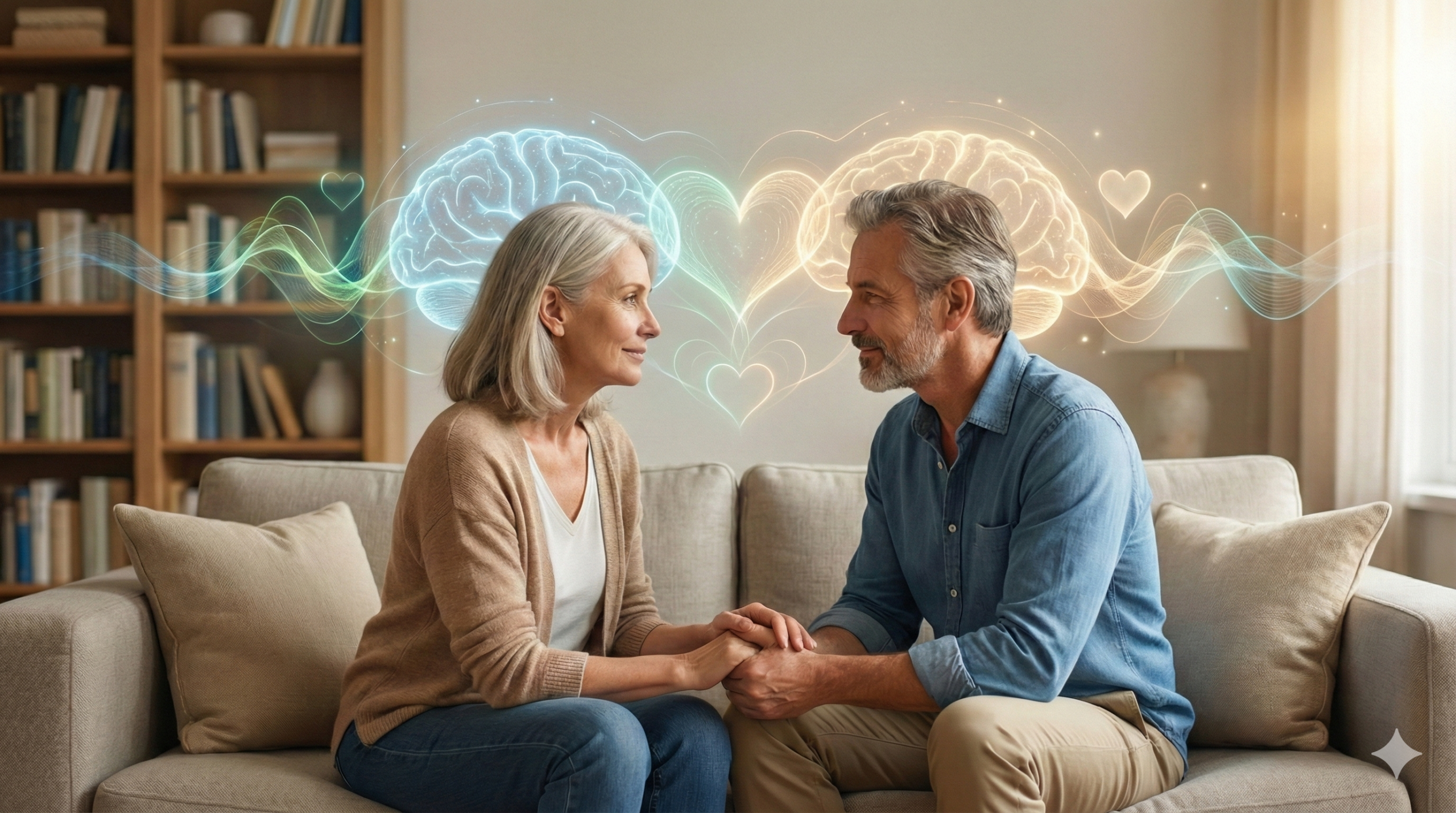
The Psychology Behind Emotional Intelligence in Love
To understand why EQ matters, we have to look at the brain. When we get into a heated conflict, our brains often suffer what psychologist Daniel Goleman calls an “Amygdala Hijack.”
The amygdala is the ancient part of the brain responsible for the fight, flight, or freeze response. When it senses a threat—even an emotional one, like a partner’s criticism—it shuts down the prefrontal cortex. That’s the part of your brain responsible for logic, empathy, and impulse control.
Low EQ relationships live in the amygdala. They are reactive. Partners feel attacked, so they attack back or shut down.
High EQ relationships engage the prefrontal cortex.
From an attachment theory perspective, emotional intelligence is what allows us to move toward Secure Attachment. A partner with high EQ can self-soothe when they feel anxious (rather than cling) and can stay engaged when they feel overwhelmed (rather than withdraw).
Research consistently shows that couples who practice “co-regulation”—the ability to help calm each other’s nervous systems—report significantly higher satisfaction levels. This isn’t magic; it’s the psychology of safety.
7 Signs Emotional Intelligence is Shaping Your Relationship
How do you know if EQ is at work in your dynamic? It isn’t just about being “nice.” It shows up in specific, observable behaviors.
Here are 7 indicators of high emotional intelligence in a partnership, specifically looking at the surface behavior versus the deeper psychological meaning.
1. The “Pause” Before the Reaction
Surface Sign: During a disagreement, your partner doesn’t immediately snap back or interrupt. They might take a deep breath, or even say, “I need a minute to process this before I respond.” They don’t send that angry text message immediately.
The Deeper Meaning: This is Self-Regulation in action. It is the ability to feel a strong emotion without being controlled by it.
Psychologically, this person is overriding their immediate impulse to defend their ego. They value the relationship more than the need to be “right” in the moment. By pausing, they are preventing “emotional flooding”—a state where the heart rate rises above 100 beats per minute, making productive conversation impossible.
2. Active Constructive Responding
Surface Sign: When you share good news—like a promotion or even finding a great parking spot—they put down their phone. They look at you. They ask follow-up questions. They match your energy.
The Deeper Meaning: This is a concept identified by researcher Shelly Gable called Active Constructive Responding.
Many people think EQ is only for crisis management. But high EQ partners understand that trust is built in the positive moments. By validating your joy, they are making a deposit into what the Gottman Institute calls the “Emotional Bank Account.” They are signaling, “Your reality matters to me.”
3. Separation of Intent from Impact
Surface Sign: You accidentally hurt their feelings. Instead of accusing you of being malicious (“You’re so selfish!”), they focus on their own experience (“When you didn’t show up, I felt unimportant”).
The Deeper Meaning: This demonstrates Cognitive Empathy.
A person with low EQ commits the “Fundamental Attribution Error”—assuming your mistakes are due to a character flaw, while their mistakes are due to circumstance. A high EQ partner separates who you are from what you did. They can hold space for the fact that you might have had good intentions, even if the impact on them was painful.
4. Curiosity Over Judgment
Surface Sign: When you act in a way they don’t understand, they get curious. Instead of saying, “That’s a stupid way to do it,” they ask, “Help me understand why you approached it that way?”
The Deeper Meaning: This is the antidote to Contempt.
Contempt (rolling eyes, mockery, hostile humor) is the single biggest predictor of divorce. Curiosity is the psychological opposite of contempt. It requires a level of humility—an admission that they don’t know everything about your internal world. This openness fosters a culture of psychological safety where you can be vulnerable without fear of ridicule.
5. Repair Attempts are Accepted
Surface Sign: You are arguing, and one of you cracks a small joke, or reaches out to touch the other’s hand. The other person softens. The tension breaks.
The Deeper Meaning: This is the acceptance of a Repair Attempt.
All couples fight. The difference between successful and unsuccessful couples is the ability to repair. High EQ partners are attuned to the emotional climate. When they sense disconnection, they try to bridge the gap. Crucially, the other partner possesses the emotional flexibility to accept that olive branch, rather than stubbornly holding onto their anger.
6. Owning the “Shadow” Side
Surface Sign: They can admit when they are being irrational, jealous, or petty. They might say, “I’m feeling really insecure right now, and I know I’m projecting that onto you.”
The Deeper Meaning: This is high-level Self-Awareness.
We all have a “shadow side”—parts of us that are fearful, greedy, or insecure. Low EQ individuals repress these traits, projecting them onto their partners. High EQ individuals integrate them. By owning their own neuroses, they prevent the toxic cycle of blame. They take responsibility for their own emotional triggers rather than demanding you tiptoe around them.
7. Boundaries as Acts of Love
Surface Sign: They can say “no” to you without being mean. They protect their energy, their time, or their values, and they respect when you do the same.
The Deeper Meaning: This is the avoidance of Enmeshment.
There is a misconception that love means merging completely. However, psychological health requires differentiation—knowing where you end and your partner begins. High EQ partners understand that boundaries aren’t walls; they are guidelines for how to love them. They set boundaries to prevent resentment, which is the silent killer of intimacy.
Common Pitfalls and Myths About EQ
As we strive to improve our emotional intelligence, it is vital to avoid common traps. Here are three myths I often see in my practice.
Myth 1: High EQ Means Never Getting Angry
The Reality: Emotions are data. Anger tells us a boundary has been crossed.
A person with high EQ feels anger just as intensely as anyone else. The difference is in the expression. They use anger as a signal to communicate a need, rather than as a weapon to punish their partner. Suppressing anger isn’t emotional intelligence; it’s emotional avoidance.
Myth 2: You Are Born With It (Or Not)
The Reality: EQ is a skill, not a fixed trait.
Unlike IQ, which is relatively static, emotional intelligence is neuroplastic. You can rewire your brain. Through practices like mindfulness, therapy, and conscious communication, you can actually physically change the neural pathways in your brain to become less reactive and more empathetic over time.
Myth 3: High EQ Means You Are Responsible for Your Partner’s Feelings
The Reality: Empathy is not the same as responsibility.
This is a dangerous trap, especially for those with “people-pleasing” tendencies. You can understand and validate your partner’s sadness without taking it on as your burden to fix. High EQ involves being with your partner in their pain, not becoming a martyr to it.
Conclusion: Building Your Emotional Toolkit
Emotional intelligence is not a destination you arrive at; it is a daily practice. It is the choice to pause when you want to yell. It is the choice to ask a question when you want to make an accusation.
If you recognize that you or your partner have room to grow in these areas, do not despair. The very fact that you are reading this article shows a willingness to learn.
Key Takeaways:
- Pause: Engage your prefrontal cortex before reacting.
- Validate: Listen to understand, not just to reply.
- Repair: Prioritize reconnection over being right.
- Differentiate: Set boundaries to maintain your own identity.
Start small. Today, try to catch yourself in one moment of reactivity. Take a deep breath. Choose a different response. That split-second decision is where the health of your relationship lives.
Frequently Asked Questions (FAQ)
Can a relationship survive if only one partner has high Emotional Intelligence?
It is difficult, but possible—with caveats. If one partner has high EQ, they can often stabilize conflicts and model healthy behavior. However, for long-term intimacy, the lower EQ partner must be willing to learn and grow. If there is a refusal to take accountability or empathize, the high EQ partner will eventually experience emotional burnout.
Is Emotional Intelligence the same as being an empath?
No. An empath feels what others feel, often involuntarily. Emotional Intelligence is the cognitive and emotional skill set used to manage those feelings. You can be an empath with low EQ (overwhelmed, reactive), and you can have high EQ without being a natural empath (learning to cognitively understand others). The best combination is managing empathy with regulation.
How can I tell the difference between high EQ and manipulation?
This is a crucial distinction. A manipulator uses their understanding of emotions to control or exploit you for their benefit. A high EQ partner uses that understanding to build connection and mutual benefit. The litmus test is the goal: Does the interaction lead to safety and trust for both of you (EQ), or does it leave you feeling confused and doubting your reality (manipulation)?
