
Quick answer: To make a budget, write down your monthly take-home pay, track what you spend for one month, and list your bills with their due dates. Then choose a simple method, give every dollar a job, automate your savings, and check in once a month. That’s it. The rest of this guide walks you through each step with real numbers.
If money feels tight, you’re not alone. In the Federal Reserve’s latest household survey, only 63% of US adults said they would cover a surprise $400 expense with cash or its equivalent. A budget is how you move into that 63%, and then well past it.
What is a budget, really?
A budget is a plan for your money before you spend it. It isn’t a punishment or a list of things you can’t have. It simply tells each dollar where to go, so the important things (rent, food, savings) are covered first and you can spend the rest without guilt.
The best budget is the one you’ll actually use. A notebook, a spreadsheet and a free app all work. What matters is that you look at it regularly.
How to make a budget in 7 steps
These steps follow the Consumer Financial Protection Bureau’s budgeting guide, plus two extra steps that make a budget last.
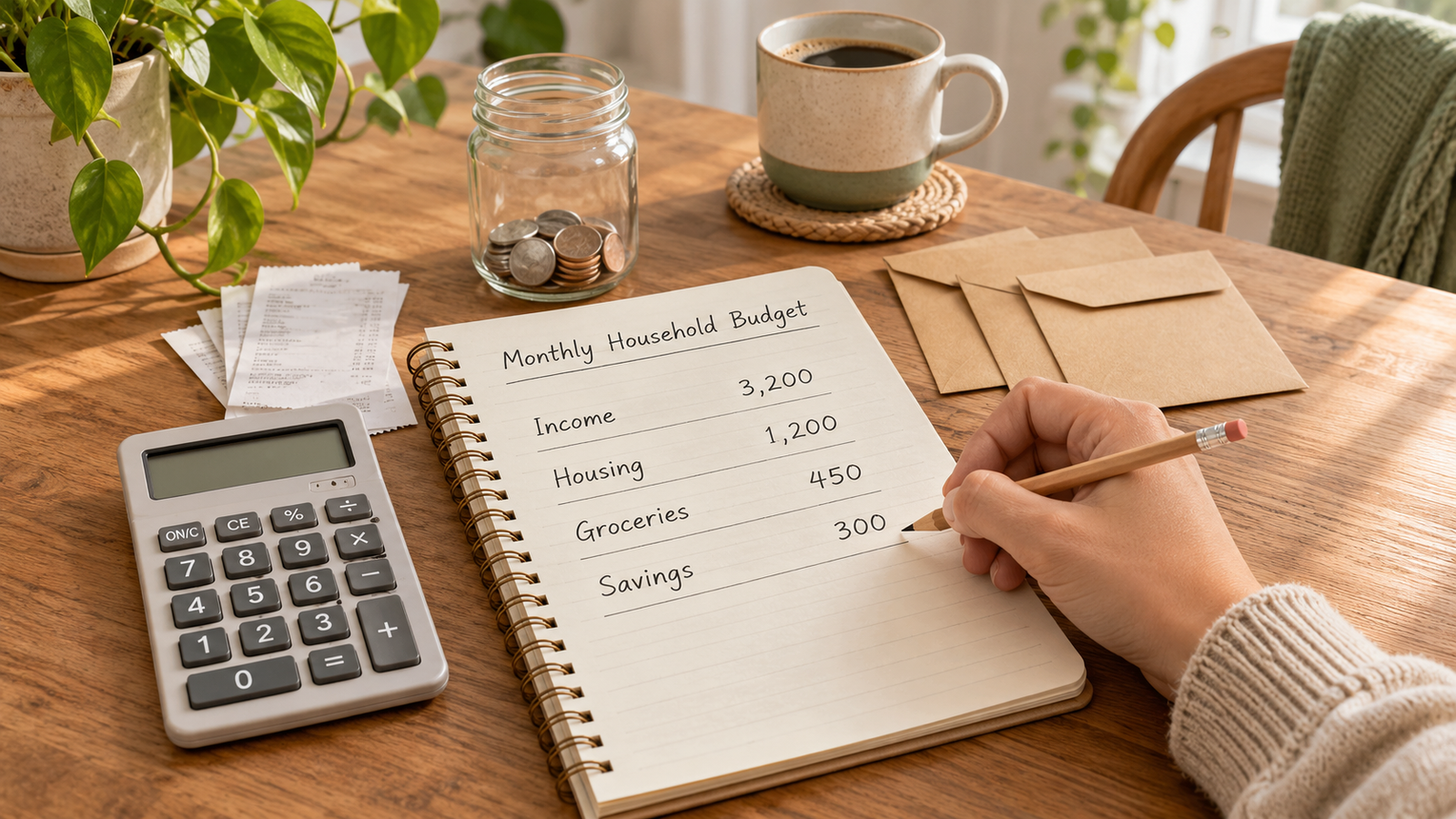
Step 1: Find your monthly take-home pay
Start with the money that actually lands in your bank account after taxes and deductions, not your salary. Include every source: your main job, side gigs, child support and any benefits.
If your income changes month to month, average the last three to six months. Then budget from your lowest month, so a slow month never breaks your plan.
Step 2: Track your spending for 30 days
Write down everything you spend for one month, including the $6 coffee and the $12 delivery fee. Your bank and credit card statements will catch most of it.
Sort each purchase into simple categories such as housing, transportation, food, debt, subscriptions and fun. If a full month feels like too much, the CFPB suggests starting with just one week.
Wondering how your spending compares? Here’s how the average US household spent its money in 2025, according to the Bureau of Labor Statistics:
| Category | Share of spending | Average per month |
|---|---|---|
| Housing | 33.9% | $2,316 |
| Transportation | 16.5% | $1,126 |
| Food | 13.0% | $887 |
| Insurance and pensions | 12.4% | $846 |
The average household spent $81,905 that year, or about $6,825 a month. Housing alone took about a third of it.
Step 3: List your bills and due dates
Write down every fixed bill (rent, car payment, phone, insurance, loan minimums) and the day each one is due. Compare those dates with your paydays.
This step catches a sneaky problem: income and bills that don’t line up. If rent is due on the 1st but you’re paid on the 5th, you’ll keep running short even if the totals work. Many companies will move your due date if you ask. Paying on time also protects your credit score.
Step 4: Pay yourself first
Decide how much you’ll save before you plan any other spending, even if it’s just $25 a paycheck. Your first goal should be a starter emergency fund of $500 to $1,000. That covers the surprise car repair or doctor’s bill that would otherwise land on a credit card.
Once the starter fund is done, work toward three to six months of expenses.
Step 5: Choose a budgeting method
Pick one method and stick with it for at least three months. The three most popular methods for beginners are compared in the next section. If you’re not sure, start with the 50/30/20 rule. It’s the easiest.
Step 6: Give every dollar a job
Now fill in your plan. Here’s a sample monthly budget for $4,000 in take-home pay using the 50/30/20 rule:
| Category | Amount | Share |
|---|---|---|
| Needs: rent, utilities, groceries, transportation, insurance, minimum debt payments | $2,000 | 50% |
| Wants: dining out, shopping, streaming, hobbies | $1,200 | 30% |
| Savings and extra debt payments | $800 | 20% |
If your needs come to more than 50%, that’s normal in high-rent cities. Take the difference out of “wants” first, and keep your savings line above zero.
Step 7: Automate it and check in monthly
Set up an automatic transfer to savings on payday, so saving happens before you can spend the money. Put fixed bills on autopay where you safely can.
Then block 20 minutes once a month to compare what you planned with what you spent. Adjust the categories that didn’t work. A budget is a draft, not a contract, and it gets easier every month.
3 budgeting methods for beginners compared
| Method | How it works | Best for | Watch out for |
|---|---|---|---|
| 50/30/20 rule | 50% of take-home pay to needs, 30% to wants, 20% to savings and extra debt payments | Beginners who want a simple guide without tracking every dollar | Hard to follow in high-rent cities, where needs alone can top 50% |
| Zero-based budget | Assign every dollar a job until income minus spending and saving equals zero | People who want full control and to know where every dollar goes | Takes more time each month, and you have to update it when plans change |
| Envelope budget (cash stuffing) | Split money into envelopes by category; when an envelope is empty, spending in that category stops | Overspenders who need a hard stop on groceries, dining out or fun money | Cash at home earns no interest and can be lost or stolen; you can use digital envelopes instead |
You can mix them too. Many people use 50/30/20 to set the big numbers, then use envelopes just for the categories where they overspend.
6 common budgeting mistakes (and easy fixes)
- Forgetting irregular expenses. Car registration, holiday gifts and annual subscriptions break budgets. Fix: add up the yearly total, divide by 12, and set that amount aside each month in a sinking fund.
- Budgeting too tightly. A plan with $0 for fun lasts about two weeks. Fix: give yourself a small, guilt-free spending amount.
- Using your salary instead of take-home pay. Taxes and deductions can take 20% or more. Fix: budget from what actually lands in your account.
- Giving up after one bad month. Everyone overspends sometimes. Fix: adjust next month’s numbers instead of quitting.
- Not tracking small purchases. $8 a day adds up to about $240 a month. Fix: check your banking app every few days.
- Saving whatever is left over. Usually nothing is left over. Fix: automate savings on payday (Step 7).
Want a quick reset? Try a no-spend challenge for one week to see how much you can free up.
Frequently asked questions
What is the easiest way to start a budget? Write down your take-home pay, then split it with the 50/30/20 rule: 50% for needs, 30% for wants and 20% for savings. You can fine-tune it after a month of tracking.
How much should I save each month? A common target is 20% of take-home pay. If that isn’t possible yet, start with any amount you can automate, even $25 a paycheck, and raise it when your income grows or a debt is paid off.
Should I use an app or a spreadsheet? Either works. Apps connect to your bank and track automatically. Spreadsheets and notebooks make you look at every number, which helps some people spend less. Choose the one you’ll open every week.
How do I budget with irregular income? Average your income over the last three to six months, then budget from your lowest month. In good months, put the extra into savings so it can cover the slow months.
How long does it take for a budget to work? Most people need about three months to get their categories right. The first month shows where your money really goes; months two and three are for adjusting.
The bottom line
You don’t need to be good with numbers to make a budget. Find your take-home pay, see where your money goes, pay yourself first and check in once a month. Start small this week. Even one category under control is progress.
Next steps: Read the 50/30/20 rule explained, or try a no-spend challenge to free up cash fast.
Sources
- Consumer Financial Protection Bureau: Budgeting: How to create a budget and stick with it
- US Bureau of Labor Statistics: Consumer Expenditures, 2025
- Federal Reserve: Economic Well-Being of US Households in 2025, Savings and Investments
This article is for general education, not personal financial advice.