Quick answer: A no-spend challenge is a set period, usually a week or a month, when you buy only essentials like rent, bills, groceries and gas. Everything else, from takeout to online shopping, is off-limits. You set the rules before you start, track each day, and move the money you didn’t spend into savings or debt.
No-spend challenges took off online in 2025. Some people used them to push back against overconsumption; others used them to cope with rising prices. They work because they turn saving into a game with a clear finish line.
How much can a no-spend challenge save?
It depends on what you normally spend on extras. Here’s a useful benchmark. In 2024, the average US household spent $3,609 a year on entertainment and $2,001 on clothing and related services, according to the Bureau of Labor Statistics. That’s roughly $300 a month on entertainment and $167 on clothing.
Pause just those two categories for one month and the average household keeps about $467, before counting takeout, coffee runs or impulse buys.
How to do a no-spend challenge in 6 steps
1. Pick your time frame
If you’re new, start with one week. A weekend is fine too. Once you’ve done a week, try 30 days. A “No-Spend January” is popular because it follows holiday spending.
2. Write down your goal
Give the challenge a reason, such as “$300 toward my emergency fund” or “pay off the $450 store card.” A specific goal makes it much easier to say no on day 9.
3. Set your rules before day one
Decide exactly what’s allowed and what isn’t, and write it down. Here’s a starting list you can copy:
| Allowed (essentials) | Not allowed (pause these) |
|---|---|
| Rent or mortgage | Takeout, delivery and restaurants |
| Utilities, phone and internet | Coffee shops and drinks out |
| Groceries from a set list | Clothes, shoes and accessories |
| Gas and public transit | Home decor and “just because” Amazon orders |
| Medicine and medical costs | New subscriptions and in-app purchases |
| Minimum debt payments | Beauty products, unless you’ve run out of a basic |
| Planned gifts already in your budget | Hobbies and entertainment that cost money |
It’s your challenge, so adjust the list. If you have kids or a long commute, make room for those needs. The point is to cut the extras, not the essentials.
4. Prepare before you start
Plan meals for the first week and do one big grocery trip. Fill the gas tank. Unsubscribe from store emails and delete shopping apps from your phone for the month. Tell a friend or partner, so someone can cheer you on.
5. Track every day
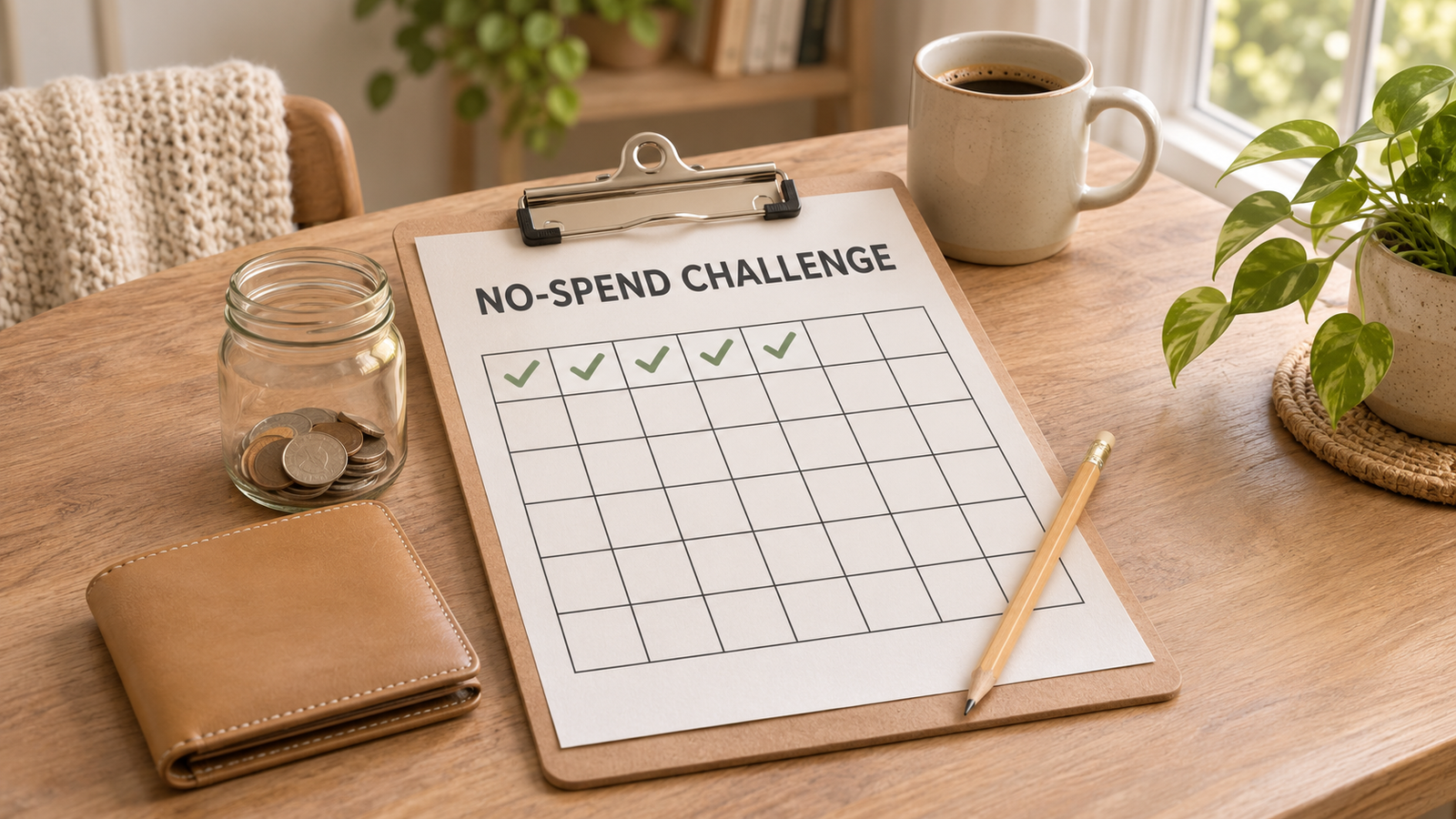
Mark each day as a no-spend day or a spend day on the tracker below. Seeing a streak of checkmarks is surprisingly motivating.
6. Move the savings right away
At the end of each week, transfer the money you didn’t spend into savings. If it sits in your checking account, it tends to disappear.
Types of no-spend challenges
- No-spend weekend: The easiest start. Plan free activities like a park, the library or a movie night at home.
- 7-day challenge: One week of essentials only. Great for testing your rules.
- 30-day challenge: The classic version, long enough to break habits.
- Category challenge: Pause just one problem category, such as takeout or clothing, for a month.
- No-spend days: Pick two or three days a week with zero spending. Good for families.
Free 30-day no-spend tracker
Print this or copy it into your notes app. Put a ✓ on every no-spend day and an ✗ on any day you spent on a non-essential.
| Week | Day 1 | Day 2 | Day 3 | Day 4 | Day 5 | Day 6 | Day 7 | Saved this week |
|---|---|---|---|---|---|---|---|---|
| Week 1 | ☐ | ☐ | ☐ | ☐ | ☐ | ☐ | ☐ | $ |
| Week 2 | ☐ | ☐ | ☐ | ☐ | ☐ | ☐ | ☐ | $ |
| Week 3 | ☐ | ☐ | ☐ | ☐ | ☐ | ☐ | ☐ | $ |
| Week 4 | ☐ | ☐ | ☐ | ☐ | ☐ | ☐ | ☐ | $ |
| Days 29–30 | ☐ | ☐ | $ |
9 tips to actually finish the challenge
- Use the 48-hour rule. If you want something, write it on a list and wait 48 hours. Most cravings pass.
- Shop your pantry first. Build a few meals from what’s already in your kitchen before buying more groceries.
- Plan free fun. Line up free activities in advance: hikes, library books and movies, free museum days, game nights.
- Remove card details saved in shopping apps and browsers. A little friction stops impulse buys.
- Carry snacks and a water bottle. A lot of “small” spending happens when you’re hungry or thirsty on the go.
- Find a challenge buddy. Doing it with a friend or partner makes it harder to quit.
- Don’t stockpile beforehand. Buying extra “before the challenge starts” just moves your spending earlier.
- Plan for birthdays and events. Agree on a gift budget now, or make something instead.
- One slip isn’t failure. Mark the ✗, note what triggered it, and keep going tomorrow.
What to do with the money you save
Give the money a job the same day you move it:
- No emergency fund yet? Put it all toward a starter fund of $500 to $1,000.
- Carrying credit card debt? Use it for an extra payment on your highest-interest card.
- Both covered? Add it to a goal fund such as a house down payment, a trip or a sinking fund.
After the challenge, add the savings to your regular monthly budget so your new habits keep paying off.
Frequently asked questions
What counts as a necessity in a no-spend challenge? Housing, utilities, groceries, transportation, medicine and minimum debt payments. Anything you’d buy “because you want it” waits until the challenge ends. You decide the exact list, as long as you set it before you start.
Can I buy groceries during a no-spend challenge? Yes. Groceries are an essential. Shop from a list, stick to basics and skip the snacks-and-treats aisle. Eating from your pantry first stretches your grocery money further.
How long should a no-spend challenge last? Beginners do well with one week. Once that feels manageable, try 30 days. Some people do a full year with a short list of allowed extras, but that takes careful planning.
What if I break the rules? Mark the day, note what triggered it and keep going. One spend day in a month still leaves you far ahead of where you would have been.
Is a no-spend challenge worth it? For most people, yes. Besides the money, it shows you which purchases are habits rather than choices. That lesson lasts after the challenge ends.
The bottom line
A no-spend challenge is one of the fastest ways to free up cash without earning more. Start with one week, write your rules, track every day and move the savings right away. Then use what you learned to build a budget that works all year.
Next steps: Try the 52-week money challenge to keep the momentum going.
Sources
- Yahoo Finance: The best and worst savings trends (December 31, 2025)
- US Bureau of Labor Statistics: Housing and transportation accounted for 50 percent of household spending in 2024
This article is for general education, not personal financial advice.