Quick answer: The best small space storage ideas on a budget use space you already have: walls, the backs of doors, under the bed and inside cabinets. Declutter first, then add vertical shelves, over-the-door organizers, under-bed bins, tension rods and furniture with hidden storage. Most of these fixes cost under $25, need no drilling, and are far cheaper than renting a storage unit.
Small homes are the norm for many renters. The average new US apartment was 910 square feet in 2025, and new studios average about 460 square feet, according to RentCafe. Below are 30 ideas, room by room, with a cost guide and a note on which ones are safe for renters.
Cost guide used below: Free = uses what you have; $ = usually under about $25; $$ = usually $25 to $75. Prices vary by store, so treat these as rough budgets.
Why fixing storage at home beats renting a unit
When space runs out, a storage unit can look like the easy answer. But it adds a monthly bill that never stops. In October 2026, the national average for a standard 10×10 storage unit was about $119 a month, and a small 5×5 about $52, according to StorageCafe.
| Option | Typical cost | Cost over one year |
|---|---|---|
| 10×10 storage unit | About $119 a month | About $1,428 |
| 5×5 storage unit | About $52 a month | About $624 |
| Decluttering plus 5–10 ideas from this list | One-time spend, often under $100 | Nothing after the first month |
More households are paying that bill. The share of US households renting at least one storage unit rose from 11.1% in 2022 to 13.4% in 2024, according to a Self Storage Association study. Before you join them, try the steps below.
Step one: declutter before you organize
Storage products can’t fix having too much stuff. Clearing out first means you buy fewer bins and get more space back.
It may also help your mood. In a well-known 2010 UCLA study of 30 working families, wives who described their homes as cluttered had a flatter daily pattern of the stress hormone cortisol, a pattern linked to poorer health. The researchers found a link, not proof of cause, but it matches what many people feel. Separate research from Princeton found that the more objects there are in view, the more they compete for your brain’s attention.
A simple 4-box declutter
- Keep: you used it in the last year and it has a home.
- Sell: it’s in good shape and worth something. Put the money toward your emergency fund.
- Donate: someone else could use it.
- Toss or recycle: broken, expired or worn out.
Work one drawer or shelf at a time, not a whole room. Then follow a one-in, one-out rule: when something new comes in, something old goes out.
Entryway storage ideas
1. Use an over-the-door shoe organizer (Cost: $, no drilling)
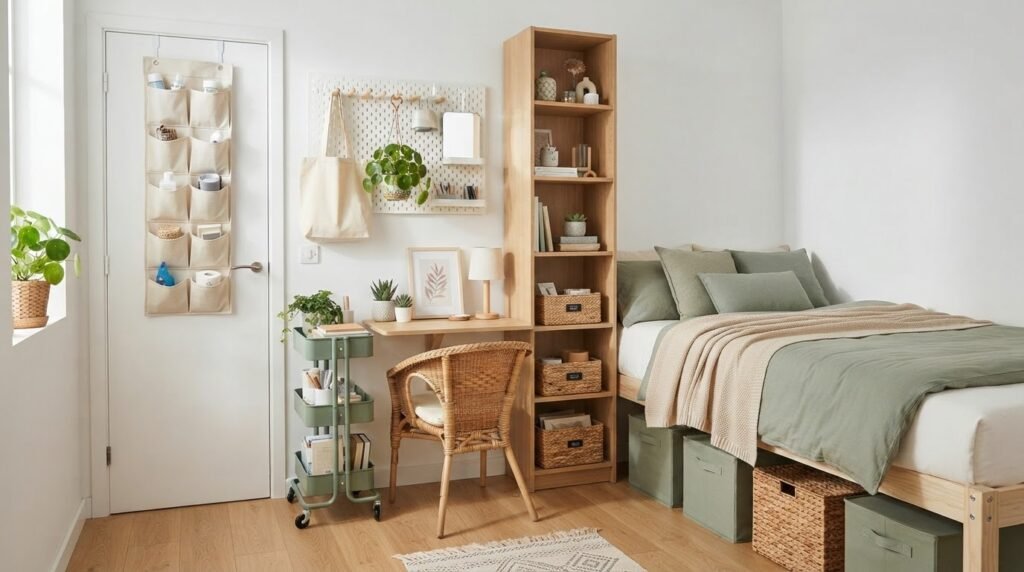
Clear pocket organizers hold shoes, but also gloves, chargers, sunglasses and cleaning supplies. Hang one on the back of the front or coat closet door.
2. Add a row of adhesive hooks (Cost: $, no drilling)
Hooks for keys, bags and dog leashes stop the pile on the counter. Check the weight limit on the package and use the right number of hooks for heavy bags.
3. Choose a bench with storage inside (Cost: $$)
A lift-top bench or one with baskets underneath gives you a place to sit and somewhere to hide shoes.
4. Keep a “landing tray” (Cost: Free)
Any small tray or bowl by the door gives keys, wallet and mail one home. Clutter often starts because things have nowhere to go.
Living room storage ideas
5. Go vertical with a tall, narrow bookshelf (Cost: $$)
A tall shelf uses wall height instead of floor space. Anchor tall furniture to the wall to prevent tip-overs; most landlords allow a small anchor screw, but ask first.
6. Use matching baskets on open shelves (Cost: $)
Baskets hide clutter and make open shelving look calm. Thrift stores often have them for a few dollars.
7. Pick an ottoman or coffee table with storage (Cost: $$)
Blankets, board games and remotes disappear inside. Look for one with a lift top or drawers.
8. Use the space behind the sofa (Cost: $$)
A narrow console table behind a sofa adds a surface and room for baskets underneath, without taking up walking space.
9. Lean a ladder shelf (Cost: $–$$, no drilling)
A leaning ladder shelf holds plants, books and throws in a small footprint and doesn’t need to be screwed into the wall.
Kitchen storage ideas
10. Add risers inside cabinets (Cost: $)
Wire shelf risers double the usable space in a cabinet, so plates and mugs don’t need to be stacked high.
11. Hang a tension rod under the sink (Cost: $, no drilling)
Spray bottles hang from the rod by their triggers, freeing the cabinet floor for other supplies.
12. Use the inside of cabinet doors (Cost: $, no drilling)
Adhesive hooks or small racks hold measuring cups, pot lids and foil boxes on space that usually goes unused.
13. Bring in a slim rolling cart (Cost: $$)
A narrow cart fits in the gap beside the fridge or washer and holds spices, cans or cleaning supplies.
14. Decant into stackable containers (Cost: $–$$)
Square containers stack and fit shelves better than bags and boxes. Clean glass jars from pasta sauce and pickles work too, for free.
15. Hang a magnetic strip or wall rail (Cost: $)
Knives and metal tools on a strip, or utensils on a rail with hooks, free up a whole drawer. Some versions stick on without drilling.
Bedroom and closet storage ideas
16. Raise the bed and use under-bed bins (Cost: $–$$, no drilling)
Bed risers add several inches of space underneath. Shallow bins or vacuum bags hold off-season clothes and spare bedding.
17. Add a second closet rod (Cost: $, no drilling)
A hanging rod that hooks onto the existing one doubles space for shirts and folded pants.
18. Switch to slim, matching hangers (Cost: $)
Thin non-slip hangers take up far less rod space than bulky plastic or wooden ones.
19. Use the closet shelf with labeled bins (Cost: $)
The high shelf is easy to forget. Bins with labels on the front make it usable for things you need a few times a year.
20. Own fewer clothes (Cost: Free)
The cheapest closet upgrade is less to store. A capsule wardrobe of pieces you actually wear frees up space fast.
21. Choose a nightstand with drawers (Cost: $$)
A small table with no storage wastes prime space. Swap it for one with drawers or a shelf, or add a basket underneath.
Bathroom storage ideas
22. Put a shelf over the toilet (Cost: $$, no drilling)
Freestanding over-the-toilet shelves use wall space that’s usually empty, with no holes needed.
23. Add a tension-rod shower caddy (Cost: $–$$, no drilling)
A pole caddy holds far more than a hanging one and stays put without drilling.
24. Use clear drawer organizers (Cost: $)
Small trays keep makeup, razors and hair ties from turning into one tangle.
25. Hang hooks instead of towel bars (Cost: $, no drilling)
Hooks hold more towels in less space, and towels dry well when hung loosely.
26. Add a slim cart beside the sink (Cost: $$)
A narrow rolling cart fits in small gaps and holds extra toilet paper and toiletries.
Whole-home and studio apartment ideas
27. Use a pegboard for flexible wall storage (Cost: $–$$)
A pegboard holds hooks, small shelves and baskets you can rearrange anytime. Hang it with a few small screws, or use a leaning frame if you can’t drill.
28. Divide a studio with an open bookshelf (Cost: $$)
An open shelf separates the bed from the living area and stores books and baskets on both sides.
29. Choose furniture that does two jobs (Cost: $$)
A storage bed, a fold-down desk or a dining bench with storage gives you extra space without extra furniture.
30. Keep one “maybe” box with a date (Cost: Free)
Not sure about something? Put it in a box, write the date on it and store it away. If you haven’t opened it in six months, donate it.
Where to find storage supplies for less
- Thrift stores for baskets, bins and solid wood shelves
- Local Buy Nothing groups and online marketplaces for free or cheap furniture
- Dollar stores for drawer trays, bins and hooks
- Discount and as-is sections at large furniture stores
- Your own recycling: shoeboxes, jars and sturdy shipping boxes work as drawer dividers and bins
Common small-space storage mistakes
- Buying bins before decluttering. You end up organizing things you don’t need.
- Ignoring weight limits on adhesive hooks and over-door racks.
- Blocking walkways with too many carts and baskets. Small rooms need clear paths to feel larger.
- Forgetting the lease. Check before drilling or painting, and keep any original hardware you remove.
Want the space to look good too? See our apartment decorating ideas on a budget.
Frequently asked questions
How can I get more storage in a small apartment without drilling? Use over-the-door organizers, adhesive hooks, tension rods, bed risers with under-bed bins, freestanding shelves and furniture with built-in storage. Always check the weight limits on adhesive products.
What is the cheapest way to add storage? Declutter first, which is free, then use what you have: shoeboxes as drawer dividers, glass jars for pantry items, and the backs of doors. Thrift stores and dollar stores cover most of the rest.
Is a storage unit worth it? It can make sense for a short move or a life change, but long term it adds up. At about $119 a month for a 10×10 unit, a year costs around $1,428.
How do I organize a studio apartment? Create zones with a rug or open bookshelf, use the space under the bed and on the walls, and choose furniture that does two jobs, like a storage bed or fold-down desk.
What should I declutter first? Start with easy categories: expired food and toiletries, duplicate kitchen tools, and clothes you haven’t worn in a year. Quick wins make the harder areas easier.
The bottom line
A small home can feel roomy with the right system. Declutter first, then use your walls, doors and the space under your bed. Most of these 30 ideas cost under $25 and need no drilling, which makes them a far better deal than paying for a storage unit every month.
Next steps: Turn the things you no longer need into cash for your emergency fund, and make your space look polished with our budget decorating ideas.
Sources
- RentCafe: US apartment sizes are growing (Yardi Matrix data, August 2026)
- StorageCafe: Storage unit prices across the US (October 2026)
- PwC and Urban Land Institute: Emerging Trends in Real Estate, self-storage outlook
- Saxbe, D. and Repetti, R. (2010). “No place like home: Home tours correlate with daily patterns of mood and cortisol.” Personality and Social Psychology Bulletin.
- McMains, S. and Kastner, S. (2011). “Interactions of top-down and bottom-up mechanisms in human visual cortex.” Journal of Neuroscience.