Quick answer: To thrift like a pro, go in with a short list and a budget, shop the racks by size and fabric rather than by brand, and run a quick quality check on every piece: seams, zippers, stains, pilling, smell and the fabric label. Try everything on, buy only what fits your wardrobe, and wash your finds before you wear them. Online resale apps work the same way: shop by measurements, not just size.
Secondhand clothes can look as good as new for a fraction of the price, but thrifting rewards a method. This guide covers where to shop, how to spot quality in seconds, how to buy secondhand online without regrets, and what to do with your finds once you get them home.
Why buy secondhand clothes?
It saves real money. The average US household spent $2,010 on apparel and services in 2025, according to the Bureau of Labor Statistics. If you bought half of your clothes secondhand at half the price, you’d cut that by a quarter, or about $500 a year.
It’s mainstream now. ThredUp’s 2026 Resale Report says the US secondhand apparel market grew nearly four times faster than the broader retail clothing market in 2025, and expects it to reach $78.8 billion by 2030.
It keeps clothes out of landfills. The EPA estimated that the US generated 17 million tons of textile waste in 2018, mostly discarded clothing. Every piece you rewear is one less new item made.
Where to shop secondhand
| Where | Best for | Prices | Watch out for |
|---|---|---|---|
| Charity thrift stores | The lowest prices and surprise finds | $ | Unsorted racks; no returns at many stores |
| Consignment and resale shops | Curated, cleaner, often brand-name pieces | $$ | Higher prices than thrift |
| Online resale apps and marketplaces | Searching for a specific item, size or brand | $–$$$ | Shipping costs, fit risk, return rules |
| Clothing swaps and Buy Nothing groups | Kids’ clothes and free basics | Free | Limited choice |
| Estate sales and church sales | Vintage coats, wool and leather | $ | Odd hours; cash only |
Before you go
1. Make a short list
Write down the two or three things you actually need, such as “black ankle boots” or “wool sweater.” A list keeps a cheap store from turning into an expensive habit. If you’re building a capsule wardrobe on a budget, use your gap list.
2. Set a budget and bring cash
Decide your limit before you walk in. Cash makes it easy to stop when it’s gone.
3. Know your measurements
Sizes vary by brand and decade, and older clothes often run small. Measure your chest, waist, hips and inseam, and the length and width of a favorite pair of jeans. A small tape measure in your bag lets you check pieces on the rack.
4. Dress for trying on
Wear fitted layers and easy shoes so you can try things on quickly. Some stores have no fitting rooms, so a slim layer lets you test tops over your clothes.
5. Learn your store’s rhythm
Many thrift stores put out new stock every day and run color-tag or weekday discounts. Ask staff when they restock and which tags are on sale.
In the store
6. Shop by size and section first
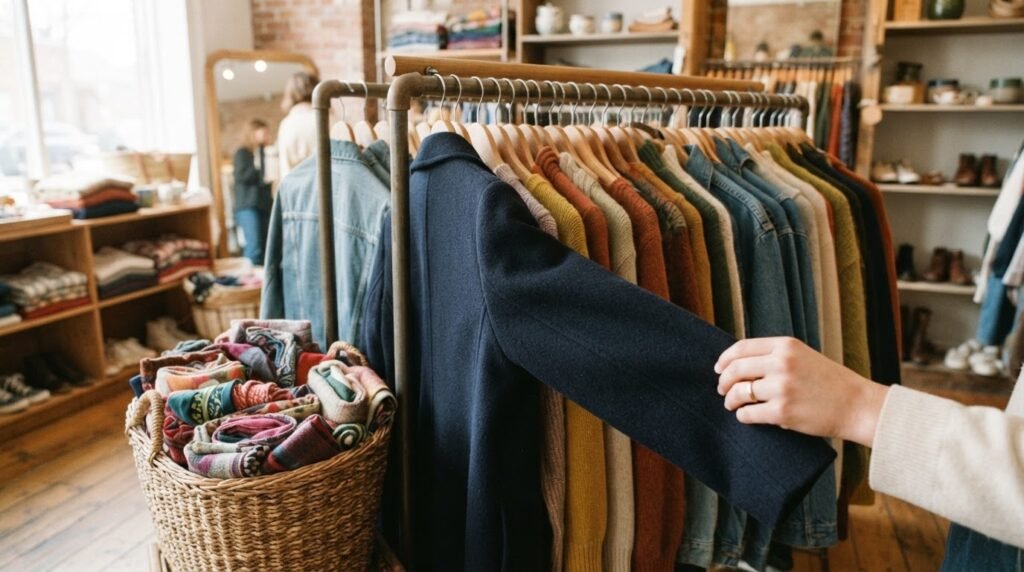
Go straight to your size in the sections on your list, then scan the racks quickly. Look at color and fabric first; read the labels on the pieces that stand out.
7. Feel the fabric
Run your hand along the rack. Thick, smooth, natural fibers like wool, cotton, linen, silk and leather often feel different from thin synthetics, and they usually age better.
8. Check the label
Clothing sold in the US must carry care instructions. The Federal Trade Commission’s Care Labeling Rule says labels must be attached permanently and stay legible for the useful life of the product. The label tells you the fabric and whether a piece needs dry cleaning, which adds to its real cost.
9. Look beyond your usual section
Men’s sweaters, shirts and coats are often roomier and well made. Kids’ sections can hold small accessories, and the home section sometimes has linen and wool fabric worth repurposing.
10. Hunt for the pieces worth buying used
Coats, wool sweaters, leather belts and bags, denim, blazers and boots are the classic thrift wins. They’re expensive new and built to last.
11. Skip the pieces that are better new
Underwear, worn-out athletic shoes and swimwear are usually better bought new. Kids’ car seats and cribs don’t belong in a clothing haul at all; buy those new or check recalls carefully.
12. Try everything on
Vintage sizing and old wear can change how a piece fits. If there’s no fitting room, check sleeve and inseam lengths with your tape measure.
13. Use the “would I buy it new?” test
Ask whether you’d buy the piece at full price if it were new. If the answer is no, the discount isn’t a good enough reason.
14. Know what a tailor can fix
Hems, sleeves and taking in a waist are usually simple. Shoulders, overall size and stretched knits are not. Only buy a piece that needs work if the fix is easy and worth the cost.
The 60-second quality check
Run through this before you head to the register:
| Check | What you want | Walk away if |
|---|---|---|
| Seams | Straight, tight stitching; tug gently | Seams pull apart or show gaps |
| Zippers and buttons | Zip runs smoothly; buttons all there | A broken zipper on a piece you can’t easily fix |
| Stains | No marks in good daylight | Stains on light fabric, underarms or collars |
| Pilling and wear | Smooth surface at elbows, cuffs and inner thighs | Heavy pilling, shine or thin spots |
| Holes | Hold it up to the light | Holes in knits, which can spread |
| Smell | Neutral | Strong smoke, mildew or musty smells |
| Shape | Collars, cuffs and hems lie flat | Stretched necklines or twisted seams |
How to shop secondhand online
15. Search by measurements, not just size
Compare the listed measurements with a piece you already own that fits. If a listing has none, ask the seller before you buy.
16. Read every photo and the description
Zoom in on fabric, seams and any flaws. Look for photos of the care and fabric label.
17. Check the return policy and the total cost
Many resale sales are final. Add shipping and fees before you decide it’s a deal.
18. Pay through the platform
Use the app’s built-in checkout, which usually includes buyer protection, and avoid sellers who ask you to pay another way. Check seller ratings and reviews.
19. Save searches
Set alerts for the exact item, brand and size on your list. It’s the online version of shopping with a list.
Shopping for kids: two safety rules
- Avoid hood and neck drawstrings. The Consumer Product Safety Commission has determined that hood and neck drawstrings on children’s outerwear in sizes 2T to 12 present a strangulation hazard. Older jackets and sweatshirts may still have them, so skip those pieces or remove the drawstrings completely.
- Check recalls. Before buying used children’s products, search the recall list at CPSC.gov.
After you buy
20. Clean everything before you wear it
Wash or dry-clean your finds according to the care label. For anything that can handle a hot dryer, the EPA says 30 minutes on high heat kills bed bugs and their eggs; washing alone might not. Use cold water for everyday washing after that to protect the fabric.
21. Keep one in, one out
When a new piece comes in, sell, swap or donate one you don’t wear. It keeps your closet small and turns old clothes into money for your next find.
How much can thrifting save?
| Share of clothes bought secondhand | Average discount | Yearly savings on $2,010 |
|---|---|---|
| 25% | 50% | About $251 |
| 50% | 50% | About $503 |
| 75% | 50% | About $754 |
These are illustrations using the BLS 2025 average. The real savings depend on what you buy and where. Savings only count if you don’t buy more because things are cheap, so stick to your list.
Frequently asked questions
Is it safe to wear thrifted clothes? Yes, once you’ve cleaned them. Wash or dry-clean everything according to the label, and use a hot dryer on items that can handle it.
What’s the best day to go thrifting? It varies by store. Many restock daily and run weekly discount days, so ask staff when new items go out and which tags are on sale.
How can I tell if secondhand clothes are good quality? Check the fabric label, then tug the seams, test the zipper, look for stains and pilling in good light, and hold knits up to the light to spot holes.
Is online resale cheaper than thrift stores? Usually not, once you add shipping and fees. Online resale is better for finding a specific item or size; thrift stores are better for the lowest prices.
What should I not buy secondhand? Underwear, worn-out athletic shoes, swimwear, and kids’ outerwear with hood or neck drawstrings. Check recalls before buying any children’s products.
The bottom line
Thrifting like a pro comes down to a list, a budget and a quick quality check. Shop by size and fabric, try everything on, skip anything you wouldn’t buy new, and clean your finds before you wear them. Over a year, that can cut your clothing spending by hundreds of dollars.
Next steps: Decide what you actually need with our capsule wardrobe on a budget guide, set a monthly clothing amount in your budget, and save for bigger pieces like a winter coat with a sinking fund.
Sources
- US Bureau of Labor Statistics: Consumer Expenditures, 2025 (October 29, 2026)
- ThredUp: 14th Annual Resale Report (April 2, 2026)
- US Environmental Protection Agency: Textiles: Material-Specific Data
- Federal Trade Commission: Clothes Captioning: Complying with the Care Labeling Rule
- US Consumer Product Safety Commission: Drawstrings in Children’s Upper Outerwear
- US Environmental Protection Agency: Preparing for Treatment Against Bed Bugs
This article is for general information. Always follow the care label on each garment.