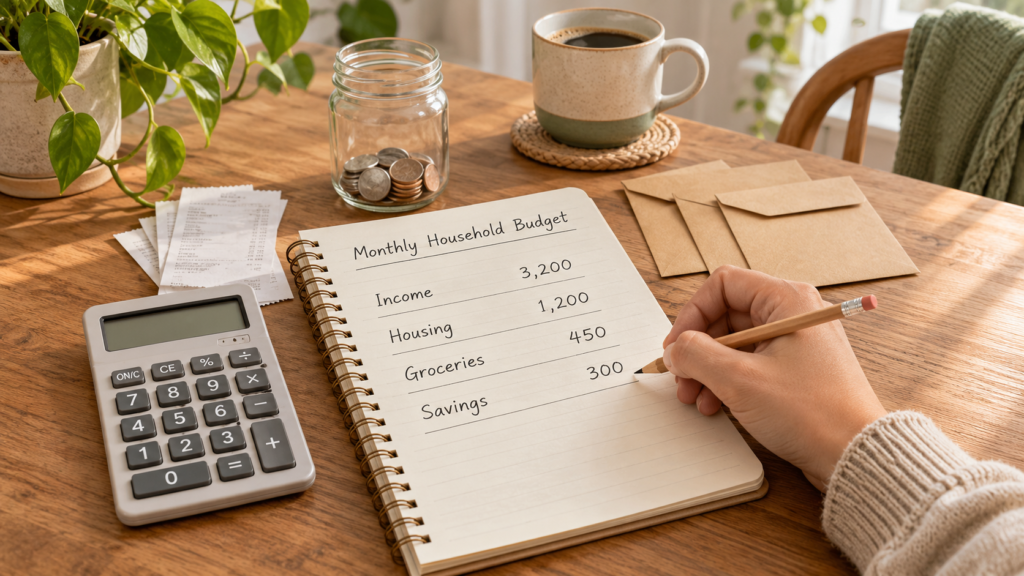
Quick answer: The fastest ways to save money on groceries are to plan meals before you shop, compare unit prices, switch to store brands, build meals around cheaper proteins such as bone-in chicken, eggs and dried beans, and stop throwing food away. In our example, just four of these changes cut about $1,770 a year from the average household grocery bill, or about 27% of what a typical household spends.
Below are 25 tips that work in 2026, with real US prices and guidance from the USDA, the Bureau of Labor Statistics and the National Institute of Standards and Technology. They’re about spending less on the same food, not about eating worse.
What groceries cost in 2026
The average US household spent $6,491 on food at home in 2025, about $541 a month, up 4.3% from 2024, according to the Bureau of Labor Statistics. Prices are still rising, but more slowly. In its November 2026 Food Price Outlook, the USDA forecasts grocery prices will rise 2.4% in 2026.
The averages hide big swings between foods, and those swings are where the savings are:
| Food | 2026 price forecast (USDA) | What to do |
|---|---|---|
| Beef and veal | Up 9.0% | Use less beef, or stretch it with beans or lentils |
| Fresh vegetables | Up 6.5% | Mix in frozen and canned vegetables |
| All groceries | Up 2.4% | Plan, compare and cut waste |
| Eggs | Down 29.5% | Lean on eggs as a cheap protein |
How much you could save: a worked example
Here’s what four tips from this list could do for a household spending the 2025 average of $6,491 a year. Prices are BLS US average retail prices for October 2026.
| Change | How we worked it out | Yearly saving |
|---|---|---|
| Buy store brands for half your cart | Store brands typically cost 25% to 30% less; we used 25% on half of $6,491 | About $811 |
| Swap boneless chicken breast for bone-in legs | $4.10 vs. $1.75 a pound, 3 pounds a week | About $367 |
| Swap 1 pound of ground beef a week for dried beans | $6.76 vs. $1.68 a pound | About $264 |
| Waste 5% less food | 5% of $6,491 | About $325 |
| Total | About 27% of the yearly grocery bill | About $1,767 |
Your numbers will differ, but the point holds: a few habits add up to real money. Put the savings toward something that matters, like your emergency fund.
Before you shop
1. Set a grocery budget
Decide what you’ll spend each month, then divide it by your shopping trips. Groceries are a need in the 50/30/20 rule, so they come out of the 50% bucket.
2. Shop your kitchen first
Check the fridge, freezer and pantry before you write a list. Plan at least two meals around what you already have.
3. Plan meals around what’s on sale
Look at the store’s weekly ad, then plan meals around discounted proteins and produce. MyPlate suggests planning a week of meals against your budget and buying what’s on sale, since stores rotate their deals.
4. Write a list and stick to it
Group the list by store section so you don’t wander the aisles. Our cheap healthy grocery list is a ready-made starting point.
5. Don’t shop hungry
Michigan State University Extension advises avoiding food shopping on an empty stomach to cut down on impulse buys. Eat a snack first.
6. Batch-cook once a week
Cooking big batches of grains, beans and proteins on the weekend means fewer takeout nights. See our guide to meal prep on a budget.
7. Pick one main store, and know its prices
Driving between five stores for deals rarely pays once you count gas and time. Choose one low-cost main store and learn the regular prices of the 20 items you buy most, so you can spot a real sale.
In the store
8. Compare unit prices, not package prices
The shelf tag usually shows a price per ounce, pound or count. MyPlate calls the unit price very useful when comparing two items. Bigger isn’t always cheaper: in one NIST example, a 64-ounce bottle of ketchup was a worse deal per ounce than a smaller bottle.
9. Watch for smaller packages
The National Institute of Standards and Technology notes that unit pricing helps you catch package downsizing, when the contents shrink and the price stays the same. Check the unit price, not the familiar package size.
10. Switch to store brands
Consumer Reports says store brands typically sell for 25% to 30% less than name brands. Start with basics where the difference is hard to taste: flour, sugar, rice, canned tomatoes, frozen vegetables, oats and milk.
11. Choose cheaper cuts and proteins
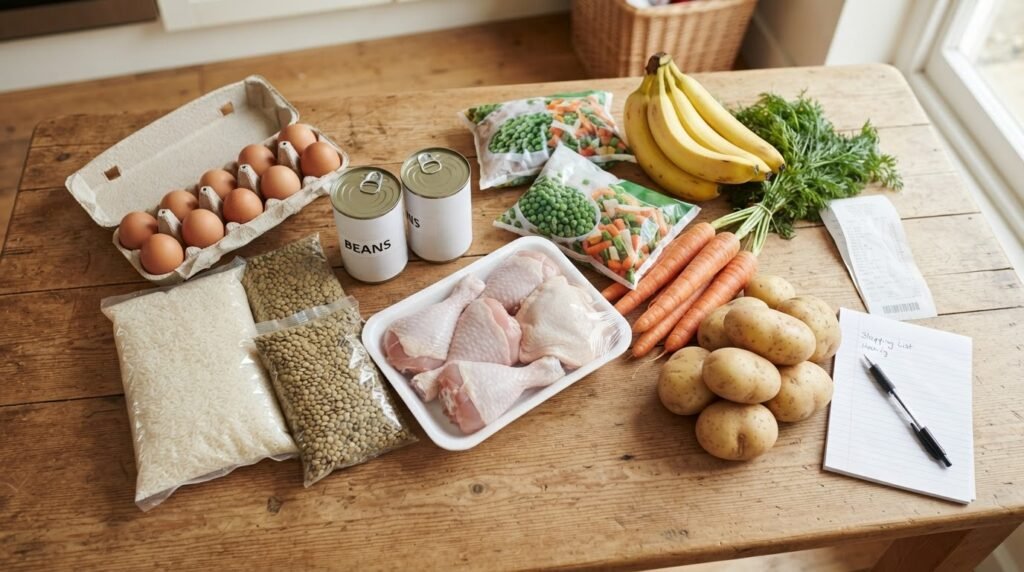
In October 2026, BLS average prices put bone-in chicken legs at $1.75 a pound, compared with $4.10 for boneless breast and $6.76 for ground beef. A dozen eggs averaged $2.32, or about 19 cents an egg.
12. Cook dried beans and lentils
Dried beans averaged $1.68 a pound in October 2026. Use them in place of some of the meat in chili, tacos and pasta sauce. Lentils need no soaking and cook in about 25 minutes.
13. Buy frozen and canned produce
MyPlate says frozen vegetables are as good for you as fresh and may cost less. They don’t spoil in the crisper drawer either. Choose canned fruit in 100% juice and vegetables labeled “low sodium” or “no salt added.”
14. Buy fresh produce in season
In-season fruit and vegetables usually cost less and taste better. With fresh vegetable prices forecast to rise 6.5% this year, mix fresh, frozen and canned depending on price.
15. Buy whole, not pre-cut
A whole head of lettuce, block of cheese or bag of carrots almost always costs less per pound than the washed, shredded or sliced version. Check the unit price to be sure.
16. Buy in bulk only what you’ll use
MyPlate suggests buying larger amounts of foods that store well, like whole grains, beans and frozen vegetables, but warns against overbuying food you’ll throw out. A big bag of rice is a deal; a giant tub of salad greens often isn’t.
Waste less food
17. Know what date labels really mean
Wasted food is wasted money. The USDA estimates 30% to 40% of the US food supply goes uneaten. Part of the problem is date labels. Except for infant formula, the dates on food aren’t safety dates, the USDA says. A “best if used by” date tells you when quality is best, not when the food becomes unsafe. Check for signs of spoilage before you throw anything out.
18. Do a weekly fridge check
Once a week, move older food to the front and plan a meal around it. Our weekly cleaning schedule builds this into Saturday. Most cooked leftovers keep for about four days in the fridge.
19. Freeze before it spoils
Bread, cooked rice, ripe bananas, grated cheese and leftovers all freeze well. Label them with the date.
20. Plan a leftovers night
Make one dinner a week from whatever needs using up: fried rice, soup, frittata or loaded baked potatoes. For more ideas, see our cheap healthy dinners for families.
Bigger savings
21. Use the store app and loyalty program
Many grocery chains offer member-only prices and digital coupons through their apps. Load coupons only for items already on your list, or they become an excuse to spend.
22. Do the math before joining a warehouse club
A Costco Gold Star membership costs $65 a year, and Sam’s Club raised its basic fee to $60 on May 1, 2026. A club pays off for larger households that use what they buy in bulk. It doesn’t if half of it ends up in the trash.
23. Cook at home more often
Eating out costs more, and its prices are rising faster. The USDA forecasts restaurant and takeout prices will rise 3.6% in 2026, against 2.4% for groceries. Households already spent $4,142 on food away from home in 2025. Swapping even one takeout night a week for a home-cooked meal makes a big difference.
24. Get help if you need it
If money is tight, SNAP, WIC and emergency food programs can help. Each state runs its own application. WIC serves pregnant, breastfeeding and postpartum women and children under five, and you can get SNAP and WIC at the same time if you qualify for both.
25. Track what you spend
Save your receipts or use your bank app for a month, and you’ll see exactly where the money goes. Then set a target and follow it with our guide on how to make a budget. For a quick reset, try a no-spend week that uses up your pantry.
Grocery mistakes that cost you money
- Buying “deals” you won’t use. Two for $5 is no saving if one goes bad.
- Shopping without a list, or with a vague one.
- Paying for convenience on things you could prep in minutes, such as shredded cheese and cut fruit.
- Throwing out food on its “best by” date when it’s still fine to eat.
- Ignoring the freezer, the best tool you have against waste.
Frequently asked questions
What is the fastest way to save money on groceries? Switch to store brands and plan meals before you shop. Store brands typically cost 25% to 30% less, and a plan with a list cuts impulse buys and waste.
How much should I spend on groceries a month? It depends on household size and where you live. The average US household spent about $541 a month on food at home in 2025. Use that as a benchmark, then set a number that fits your budget.
Are store brands as good as name brands? Often, yes, especially for basics like flour, rice, canned goods and frozen vegetables. Consumer Reports says store brands have improved in quality and variety. Try one swap at a time and keep the ones you like.
Is it cheaper to buy groceries in bulk? Only for foods you’ll use before they spoil and that you have room to store. Compare unit prices, because the bigger package isn’t always cheaper.
Is food safe to eat after the “best by” date? Usually. Except for infant formula, date labels are about quality, not safety. Food that’s been stored properly and shows no signs of spoilage is generally fine. If in doubt, throw it out.
The bottom line
Saving money on groceries comes down to a few habits: plan before you shop, compare unit prices, choose store brands and cheaper proteins, use frozen and canned produce, and stop throwing food away. Together, they can cut the average grocery bill by hundreds or even more than a thousand dollars a year, without eating less or eating worse.
Next steps: Start with our cheap healthy grocery list, plan the week with cheap healthy dinners, and read more on how to eat healthy on a budget.
Sources
- US Bureau of Labor Statistics: Consumer Expenditures, 2025 and Average retail food prices, US city average (October 2026)
- USDA Economic Research Service: Food Price Outlook, 2026 (updated November 24, 2026)
- USDA: Food Loss and Waste FAQs
- USDA Food Safety and Inspection Service: Food Product Dating
- USDA MyPlate: Shop Smart and Eat Healthy on a Budget
- National Institute of Standards and Technology: Unit pricing guide
- Consumer Reports: How store-brand groceries can help you save
- Michigan State University Extension: How to stretch your food budget
- NerdWallet: How much is a Costco membership?; Southern Living via AOL: Sam’s Club membership price change
- USA.gov: Food assistance
This article is for general information. Prices are national averages and vary by store and region. If anyone in your household has a food allergy or special diet, check with a doctor or registered dietitian before making big changes.