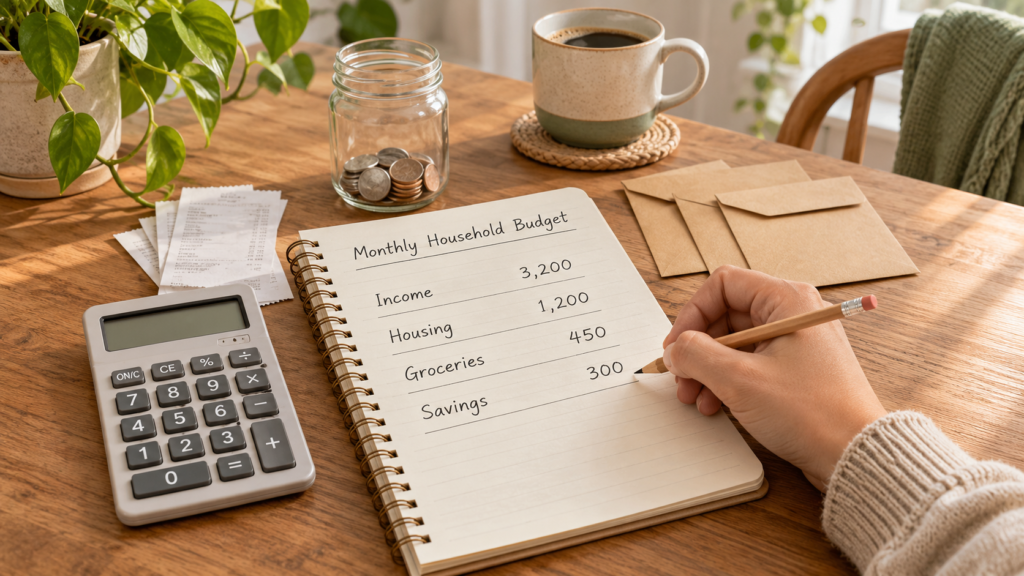
Quick answer: To save money for a house, set a target that covers your down payment plus 2% to 5% of the loan for closing costs, then divide it by the months until you want to buy. Keep the money in a separate, FDIC-insured high-yield savings account, and automate a transfer every payday. Cut your biggest costs first, save every windfall, and check for down payment assistance in your state, which can shrink the amount you need.
The free calculator below shows how much to save each month for your goal. After that, you’ll find what a home really costs in 2026, how big your down payment needs to be, and nine steps to get there faster.
House savings calculator
Enter your target price and timeline. The starting values use the October 2026 national median home price and a 10% down payment.
Down payment: $41,670
Closing costs: $11,251
Extra cushion: $0
Total savings goal: $52,921
Save each month: $1,388 (about $640 per paycheck if you’re paid every two weeks)
Interest you could earn along the way: about $2,971
The calculator assumes monthly deposits and monthly compounding at the rate you enter. Savings rates change often, so use the rate your bank actually pays.
How much you need to save for a house in 2026
The median existing home sold for $416,700 in October 2026, according to the National Association of Realtors (NAR). You don’t need 20% down. In NAR’s 2026 survey of recent buyers, the median first-time buyer put down 9%, and repeat buyers put down 19%.
Here’s what different down payments mean for a median-priced home, including closing costs of 2% to 5% of the loan amount, the typical range given by lenders such as Chase:
| Down payment | Amount on $416,700 | Closing costs (2%–5% of loan) | Estimated monthly payment* |
|---|---|---|---|
| 3.5% (FHA minimum) | $14,585 | $8,042–$20,106 | $3,414 |
| 5% | $20,835 | $7,917–$19,793 | $3,369 |
| 10% | $41,670 | $7,501–$18,752 | $3,218 |
| 20% (no mortgage insurance) | $83,340 | $6,667–$16,668 | $2,779 |
*Our estimate: a 30-year fixed loan at 7.21% (Freddie Mac’s average for the week of November 25, 2026), property tax of 1% of the price a year, $2,000 a year for homeowners insurance, and mortgage insurance of 0.5% of the loan a year with less than 20% down. Your rate, taxes and insurance will differ. For your own numbers, use our how much house can I afford calculator.
A bigger down payment lowers your monthly payment and removes mortgage insurance, but it takes much longer to save. On a median-priced home, the difference between 10% and 20% down is $41,670 more in savings for about $439 a month off the payment.
How big should your down payment be?
- 0% down: VA loans (for eligible service members and veterans) and USDA loans (for eligible rural areas).
- 3% down: some conventional loans, such as Fannie Mae’s HomeReady and Freddie Mac’s Home Possible, for borrowers within income limits. HomeReady requires a credit score of at least 620.
- 3.5% down: FHA loans, with a credit score of 580 or higher.
- Less than 20% on a conventional loan: you’ll pay private mortgage insurance (PMI). The Consumer Financial Protection Bureau explains that you can ask to cancel PMI once your balance reaches 80% of the home’s original value, and it ends automatically at 78% if you’re current on payments.
A smaller down payment can get you into a home sooner, which matters if rent is high. Just make sure the monthly payment still fits your budget and that you’ll have savings left after closing.
How to save money for a house in 9 steps
1. Set your target number
Add up three things: your down payment, closing costs, and a cushion for moving, small repairs and basic furniture. Keep your emergency fund separate. You’ll want three to six months of expenses left over after you buy, because new homes come with surprise repairs.
2. Pick a timeline and do the math
Divide your goal by the months you have. For a 10% down payment plus 3% closing costs on a median-priced home ($52,921), you’d need to save about $1,388 a month for 3 years, or about $800 a month for 5 years, at a 4% savings rate. If those numbers feel out of reach, lower the target price, choose a smaller down payment, or give yourself more time.
3. Open a separate high-yield savings account
Keep house money away from your checking account, where it’s too easy to spend. The interest rate matters: the FDIC’s national average savings rate was 0.39% in November 2026, while many online high-yield accounts pay around 4%. On the 3-year plan above, that’s roughly $300 of interest at the average rate versus about $2,971 at 4%.
Choose a bank insured by the FDIC or a credit union insured by the NCUA. Money you’ll need within a few years is usually kept out of the stock market, because prices can fall right when you need to buy.
4. Automate it like a bill
Set up an automatic transfer on payday, so you save before you can spend. Treat it like any other bill. If you already use sinking funds, make “house” one of them, with its own target and deadline.
5. Cut your biggest costs first
Small cuts help, but big ones move the needle. Look at your three largest expenses, usually rent, transportation and food. A cheaper apartment, a roommate, one car instead of two, or cooking at home can each free up hundreds a month. Our guides on how to stop spending money and how to save money on groceries have more ideas.
6. Save every windfall
Send tax refunds, bonuses, raises and side-gig income straight to your house fund. When you get a raise, increase your automatic transfer by at least half of it before you get used to the extra money.
7. Look for down payment assistance
Thousands of state and local programs help buyers with down payments and closing costs. Freddie Mac says there are more than 2,500 programs nationwide, offered as grants, forgivable loans or low-cost second loans. Start with HUD’s list of local homebuying programs by state and your state’s housing finance agency, and ask your lender what you might qualify for. Many programs have income limits and require a homebuyer education class.
8. Know the rules for gifts and retirement money
In NAR’s 2026 survey, 62% of first-time buyers used personal savings, 30% used financial assets such as a 401(k) or stocks, and 25% used gifts or loans from family and friends.
- Gifts: lenders usually ask for a signed gift letter and records showing where the money came from. Ask your lender about its rules early.
- IRAs: the IRS lets qualifying first-time homebuyers withdraw up to $10,000 from an IRA without the usual 10% early withdrawal penalty. Income tax may still apply. This exception doesn’t apply to 401(k) withdrawals.
- Retirement trade-off: money taken out of retirement accounts stops growing for retirement. Talk to a tax professional before you use it.
9. Protect your credit while you save
Your credit score affects your mortgage rate, and even a small rate difference adds up over 30 years. Pay every bill on time, keep credit card balances low, and avoid opening new loans or cards in the months before you apply.
Frequently asked questions
How much should I save for a house? Plan for your down payment (often 3% to 20% of the price), plus closing costs of about 2% to 5% of the loan, plus a cushion for moving and repairs. For a $416,700 home with 10% down, that’s about $49,000 to $60,000 before the cushion.
How long does it take to save for a house? It depends on your goal and how much you can save. At $800 a month and a 4% savings rate, it takes about 5 years to reach $52,921. Assistance programs, a lower price or a smaller down payment can shorten that.
Do I need 20% down to buy a house? No. FHA loans allow 3.5% down with a credit score of 580 or higher, some conventional loans allow 3%, and VA and USDA loans can require nothing down. With less than 20% down on a conventional loan, you’ll pay mortgage insurance until you reach enough equity.
Where should I keep my house savings? In a separate, FDIC- or NCUA-insured high-yield savings account, or in CDs timed to your purchase date. Avoid investing money you’ll need in the next few years in stocks.
Can I use my 401(k) for a down payment? Some plans allow loans or hardship withdrawals, but there’s no special 10% penalty exception for first homes from a 401(k). The $10,000 first-time homebuyer exception applies to IRAs. Check with your plan and a tax professional first.
The bottom line
Saving for a house is a math problem with a deadline. Set a target that includes closing costs, divide it by your months, and automate the transfer into a separate high-yield account. Cut your biggest expenses, save every windfall, and check for down payment assistance before you decide you need 20%.
Next steps: Find a realistic price range with our how much house can I afford calculator, set up your house savings as a sinking fund, and make room in your plan with our guide on how to make a budget for beginners.
Sources
- National Association of Realtors: Existing-Home Sales, October 2026 (November 12, 2026) and 2026 Profile of Home Buyers and Sellers (November 5, 2026)
- Freddie Mac: Primary Mortgage Market Survey (November 25, 2026) and How down payment assistance programs can help
- Consumer Financial Protection Bureau: When can I remove private mortgage insurance (PMI) from my loan?
- US Department of Housing and Urban Development: Local Homebuying Programs
- Internal Revenue Service: Topic 557, Additional tax on early distributions from traditional and Roth IRAs
- FDIC via FRED: National Rate: Savings (November 2026)
- Fannie Mae: HomeReady Mortgage
- Chase: What are closing costs and how much are they?
This article is for general education, not personal financial, tax or legal advice. Loan programs, rates and assistance rules change; check current terms with your lender and your state housing agency.